Grow College Green (part 2)
A short update to my recent article on Grow College Green. Here's what I wrote in on behalf of the Dublin Bay North branch of the Social Democrats.
Public Realm and Materials
College Green is currently a cluttered space with signs and poles and that weird electrical box henge. Removing that clutter will by itself make the space seem much calmer and a place people will want to spend time in. It’s important for the design team to make the case that excessive signage has a negative effect on the public realm and therefore it should be kept to the absolute minimum.
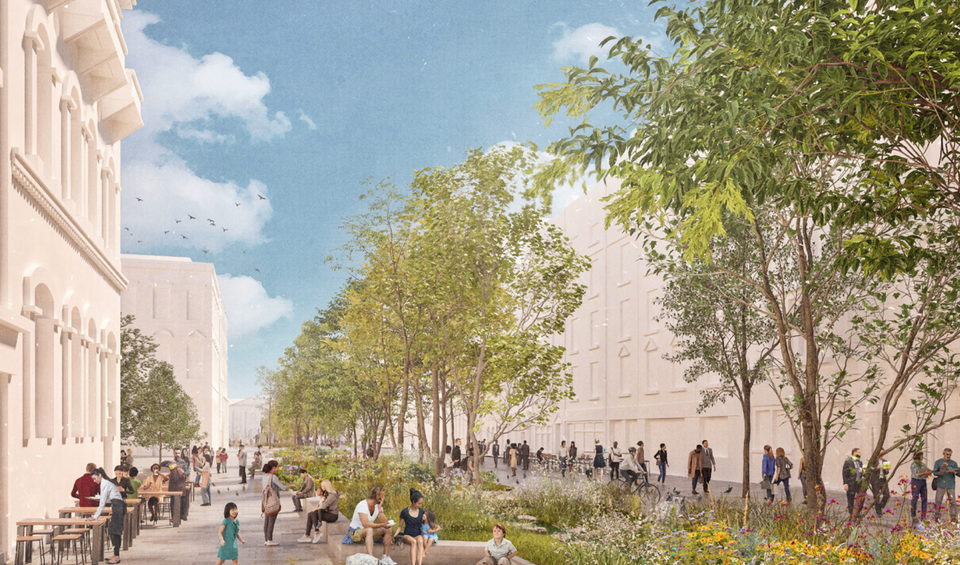
The images in the brochure don’t really match the colour palette of the built environment in College Green - the pics are more cream / brown tinged relative to the rather grey stone fronts of the existing buildings. Whatever happens in the final design, it would be good if it did not resemble a granite plaza, so using materials like wood or brick (as well as plenty of greenery) will soften it somewhat. It’s not that there shouldn’t be any granite, but it should not dominate.
The level of greenery in the images is really welcome, it feels like a cross between a park and a plaza. Given Ireland’s weather conditions, having trees and other greening will help prevent the place becoming windswept when the weather’s not great. This is a problem we have in Smithfield and on Grand Canal Dock - the plazas look good when the sun is shining, but can become a bit windswept and unpleasant to spend time in at night and in winter.
Transport links
This change of use of College Green has a material impact on the provision of public transport in Dublin. I would like the Grow College Green team to liaise with the NTA to conduct a public transport / connectivity audit - what is the public transport route to here from various points in the city and surrounding areas, how many mode changes are required and what is the expected travel time?
Bear in mind that not everyone is capable of moving around well on foot - how will the location of this plaza and the public transport changes needed to facilitate it impact on people with different mobility needs (parents with small children, elderly or otherwise mobility-impaired people)? This location has reasonable connections to the southside via bus and Luas, but once we get to the northside it's much more difficult - the 123 bus served college Green from Marino but it has been replaced with the 73, which goes to the quays - a 360m walk from the front of Trinity College. I would like the team to reflect on whether it is reasonable to ask an elderly or visually impaired person to make that journey? Is it equitable - are we in danger of providing a public amenity that is essentially unreachable to a cohort of Dubliners?
Seating
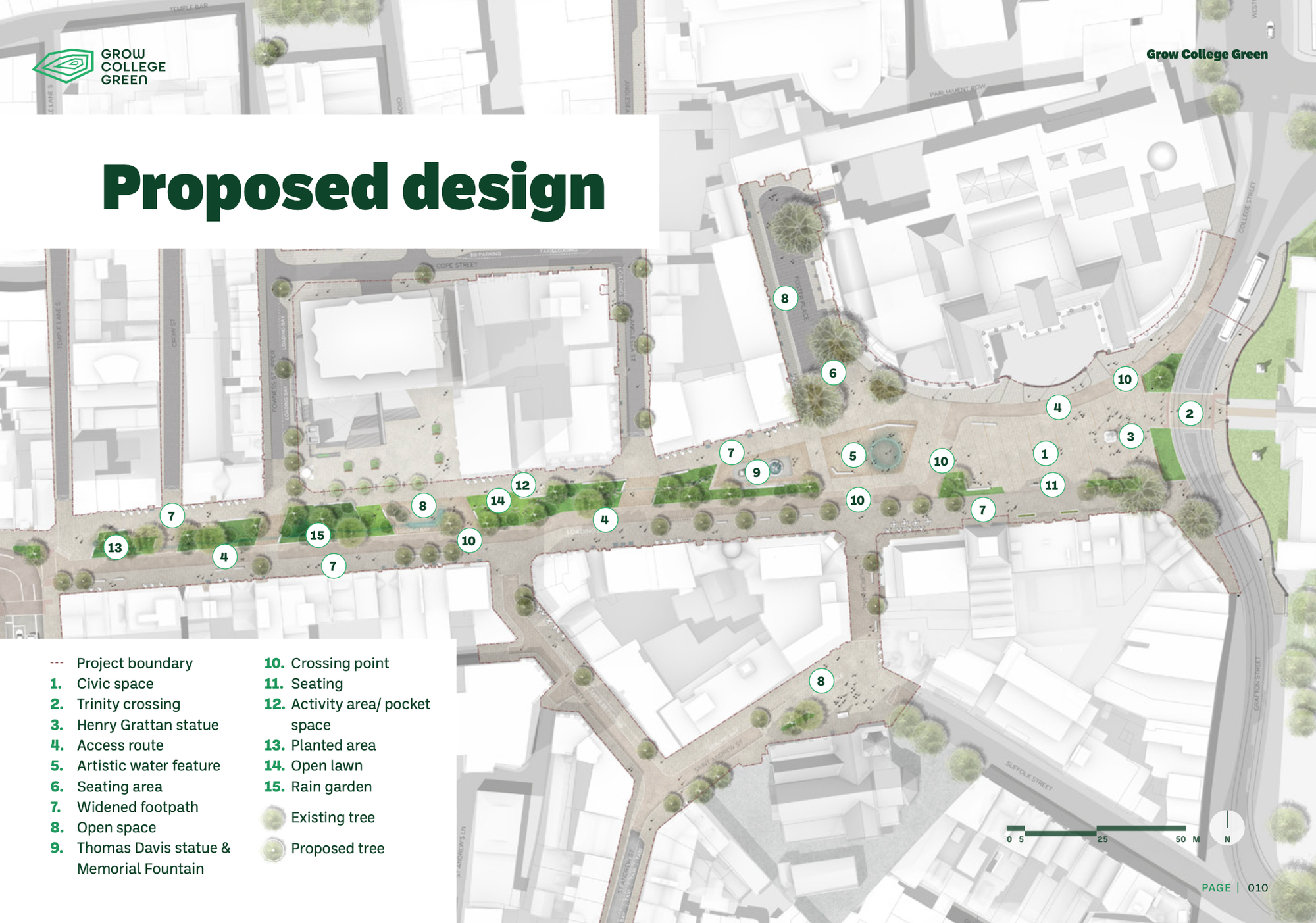
We would like to see lots of seating. The proposal has only 2 seating areas and nothing shown to the west of Foster Place. Additional seating further along Dame St would be welcome - some seating near the western end of the planted area between Temple Lane and Crow St would be useful for people entering the area from the west.
Toilets
Dublin has a dire lack of public toilets - this has the effect of making the city centre less inviting for older people, women, disabled people, children and families, and people with caring responsibilities - essentially anyone who is not a worker with access to toilet facilities in their place of work. The purpose of a design like this is to invite Dubliners into their city to activate and animate the streets - toilets are a key part of that offering. There should be public toilet provision as part of this development.
Water feature
The Thomas Davis statue and fountain is welcome, there are not enough fountains in Dublin. It would be nice if the fountain could double as a paddling area for children - something like the Disappearing Rooms on the South Bank in London would be a good reference point. Combining a water feature play space with some seating nearby would animate the space and allow parents / carers to keep an eye on the children playing in the fountain.
Shared space for cycling and walking
It’s important to have physical separation between cyclists and pedestrians (more correctly, between fast and slow modes of travel). Older people / children / people with sensory issues will not feel safe in a space that is also being used as a thoroughfare by cyclists / scooters moving at 20 km/h (or more - it’s illegal, but it happens and the design should acount for it).
There isn’t really a practical way to get cyclists to slow down in shared spaces - we might be able to appeal to the civic mindedness of leisure / casual cyclists but delivery riders are on the clock and will go as fast as they can. So if we are to allow cycling and scooting through this space we should confine the faster moving modes to a segregated area. A potential alternative is to route bikes around the outside of the space. See Capel St or Grand Canal Dock to get a sense of how shared walking / cycling spaces work in practise - conflicts are common!
Shelter
As mentioned above, the weather in Ireland means we have cold, damp nights and 4-5 months of the year where it’s not comfortable to gather outdoors. This could be mitigated somewhat by using planting or screens to break the airflow around College Green so that it doesn’t fall foul of the “wind tunnel effect” that we sometimes experience in Smithfield or Grand Canal Plaza.
Conversely, we get plenty of sunshine in the summer months, so it’s important to make sure there is plenty of shade from trees to help the place feel cooler on warm days.